

Rooted In Community, Built To Thrive: Inside America's Largest Privately Owned Bank
As seen in Forbes.com - view the article here.
June 25, 2026
OKLAHOMA CITY, OK – At a time when many banks are navigating volatility and short-term shareholder pressure, Oklahoma-based MidFirst Bank stands apart. Its long-term operating philosophy has made it the largest privately owned bank in the nation and one of the strongest and best capitalized.
What differentiates MidFirst is not simply scale, but the culture private ownership has enabled. The bank has focused on building enduring relationships, making measured decisions and operating with discipline across economic cycles; defining itself as much by responsible stewardship as by financial performance.
"Our goal has always been to build long-term relationships, invest in our community and create a bank that will stand the test of time."
— Jeffrey Records, Jr., Chairman of MidFirst Bank
As CEO for more than three decades, Jeff Records transformed MidFirst from a $4 billion regional institution into a national bank with more than $42 billion in assets, instilling a philosophy of stewardship focused on managing capital, relationships and risk for the long term. Today, with Records as Chairman and Todd Dobson – his colleague of more than 30 years – as CEO, the bank benefits from uncommon continuity at the top and a deeply tenured leadership team that has been shaped over decades.
Private Ownership as a Strategic Advantage
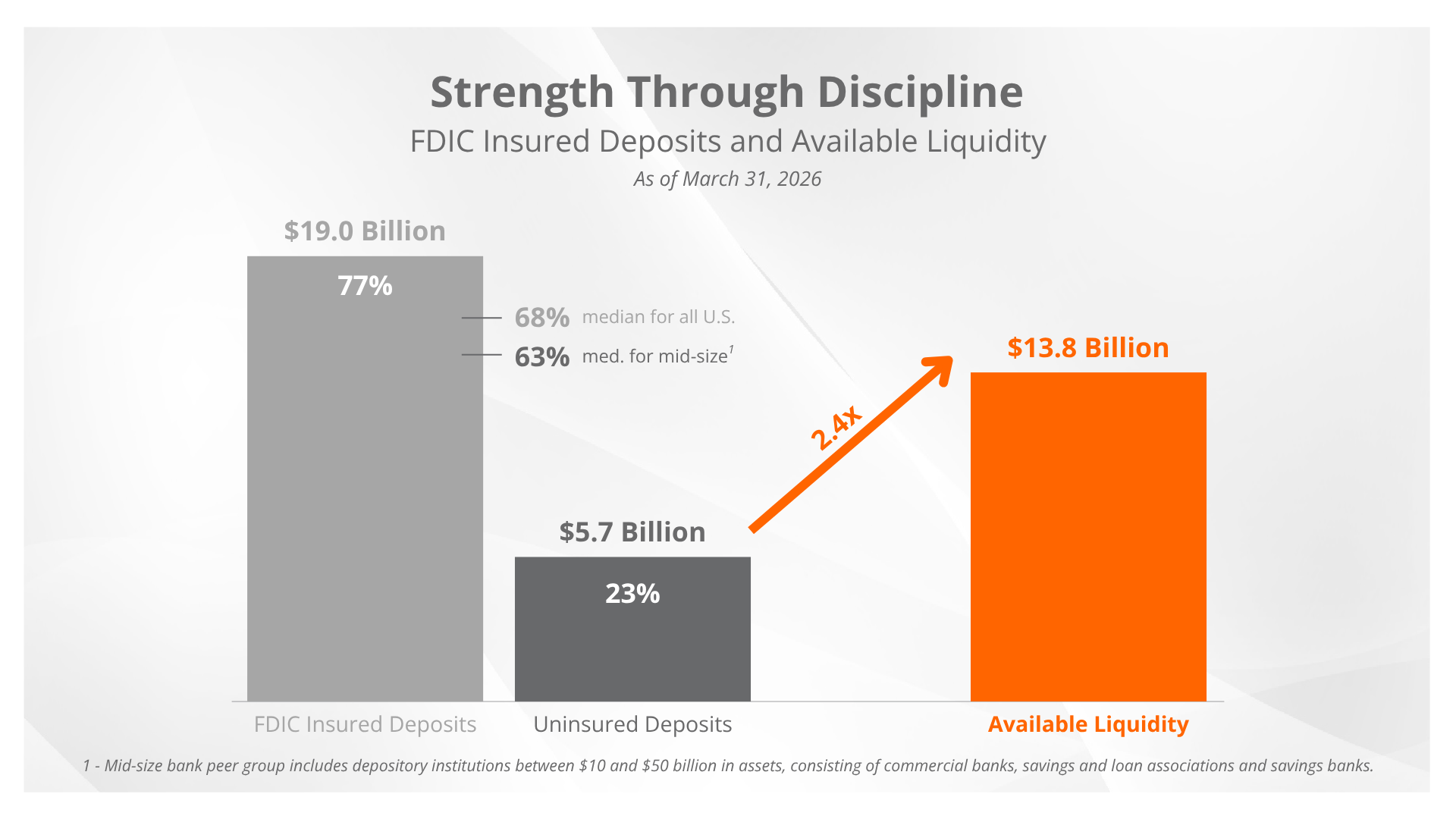
For MidFirst, private ownership is more than an organizational structure; it is a competitive edge, and the results are measurable. The bank has delivered four consecutive decades of profitability while maintaining one of the strongest capital positions in the industry. With a total risk-based capital ratio of 19.7%, ranking in the 91st percentile among peers, and $13.8 billion in available liquidity as of March 31, 2026, MidFirst is built for resilience. The bank also benefits from a highly stable funding base, with nearly 80% of deposits FDIC-insured – well above the industry average of roughly 63%. Net charge-offs across the prior 12 months total just 0.04% of average loans, more than half of its assets are government-guaranteed, and its loan and deposit portfolios are strong and highly diversified. These metrics aren't incidental; they reflect a deliberate, decades-long commitment to stability and prudent stewardship.
Throughout the financial crisis of 2008, the pandemic beginning in 2020 and the banking instability of 2023, MidFirst remained steady and profitable – preserving the flexibility to keep investing and serving customers. In 2023 specifically, that approach became a clear advantage. Supported by a conservative balance sheet and sustainable liquidity, MidFirst attracted deposits, strengthened relationships and added experienced banking teams in attractive markets while competitors pulled back. Many of those teams were drawn not only to the bank's financial strength but to its culture: a relationship-driven environment with long-tenured leadership and a reputation for treating clients and employees with care and respect.
“In business, trust matters,” said W&W AFCO Steel Chairman and CEO Rick Cooper. “You want partners who will be there when things are going well, but it’s more important to have someone there when things get tough. MidFirst has been that kind of partner to us. They bring the strength and capabilities of a large institution but still make you feel like you’re working with people who genuinely care about your success. That’s a rare combination today and one of the reasons we’ve valued our partnership for so many years.”
Growth by Design
MidFirst has pursued expansion patiently and intentionally, entering markets with the expectation of staying and building. In California, this began with the 2016 acquisition of 1st Century Bank in Los Angeles and has since produced growth of more than 400%, with high-performing teams now operating across Los Angeles, San Diego, Santa Barbara, Newport Beach and San Francisco – recently unified under the MidFirst brand. The bank has further expanded throughout Arizona, Colorado, Nevada, Texas and Utah through acquisitions and by recruiting experienced bankers and opening new offices.
Building on that disciplined growth strategy, in June 2026 MidFirst announced plans to acquire Dallas Capital Bank, a $1.2 billion asset institution that further strengthens its commercial and private banking capabilities in the Dallas-Fort Worth market while adding a highly respected team of banking professionals.
Culture as Competitive Advantage
MidFirst has built a reputation for combining discipline with approachability, ambition with humility, and a deep commitment to relationships in the way it serves both customers and employees. That culture starts at the top. As CEO, Dobson has embraced the leadership principles established by Records. That continuity is evident in how decisions are made, how people are treated and in how the institution’s guiding principles are preserved even as the bank grows. Employees are encouraged to think long term and prioritize relationships over transactions. More than 30% of employees have been with the bank for over a decade, which translates to faster decisions, stronger risk management and more consistent execution.
Even with its national scale, MidFirst maintains a distinctly community-bank mindset. Whether serving a private wealth client or a customer opening their first checking account, the employee expectation is the same: treat people fairly, respond thoughtfully and build trust over time.
Programs like True Moments, which recognizes bank employees for exceptional acts of service, reinforce MidFirst’s belief that customer service, sound judgment and accountability go hand in hand. The same philosophy is evident in the bank’s investment in U.S.-based call centers, where dedicated professionals deliver efficient and personalized service.
Community Focused
Community investment is integral to how MidFirst conducts business. Its deep roots in Oklahoma City – including its role as a founding partner of the NBA's Thunder, its partnerships with schools and universities, its position as a major employer, and its recent purchase of a 250,000-square-foot building to expand its headquarters – reflect a commitment that hasn't wavered even as the bank has grown nationally. That commitment extends to California, where the acquisition of the historic 100,000-square-foot Maxwell Building in the Los Angeles Arts District signals long-term confidence in the region.
Across markets, MidFirst's community engagement is evident. The bank has contributed hundreds of millions of dollars to support charitable and civic efforts, and its financial literacy programs have reached more than 300,000 participants with partnerships like the University of Oklahoma's MoneyCoach program delivering practical tools for financial empowerment.
“People remember who shows up for them, and MidFirst has been showing up for Oklahoma for a long time,” said University of Oklahoma President Joseph Harroz, Jr. “By supporting students, strengthening communities and helping people build brighter futures, they’ve earned the trust and respect of people across our state. Commitment isn’t just something they talk about at MidFirst, it’s something they demonstrate year after year and their leadership has left a lasting impact.”
The Future: Purposeful Growth
As MidFirst looks ahead, the principles that shaped its past remain firmly in place. The bank’s next phase will be defined by continued expansion into high-growth markets, the selective addition of talent and capabilities, and the thoughtful, strategic deployment of capital when opportunities emerge – guided by a leadership team with the experience and institutional knowledge to navigate complex environments while preserving the culture, approach and legacy that define the bank.
In an industry characterized by market cycles and short-term thinking, MidFirst offers a durable lesson: knowledge and consistency, applied over time and reinforced through hard work and discipline, can become the most effective competitive advantage.